
 | Proudly Serving the Central Valley | 24/7 On Call Service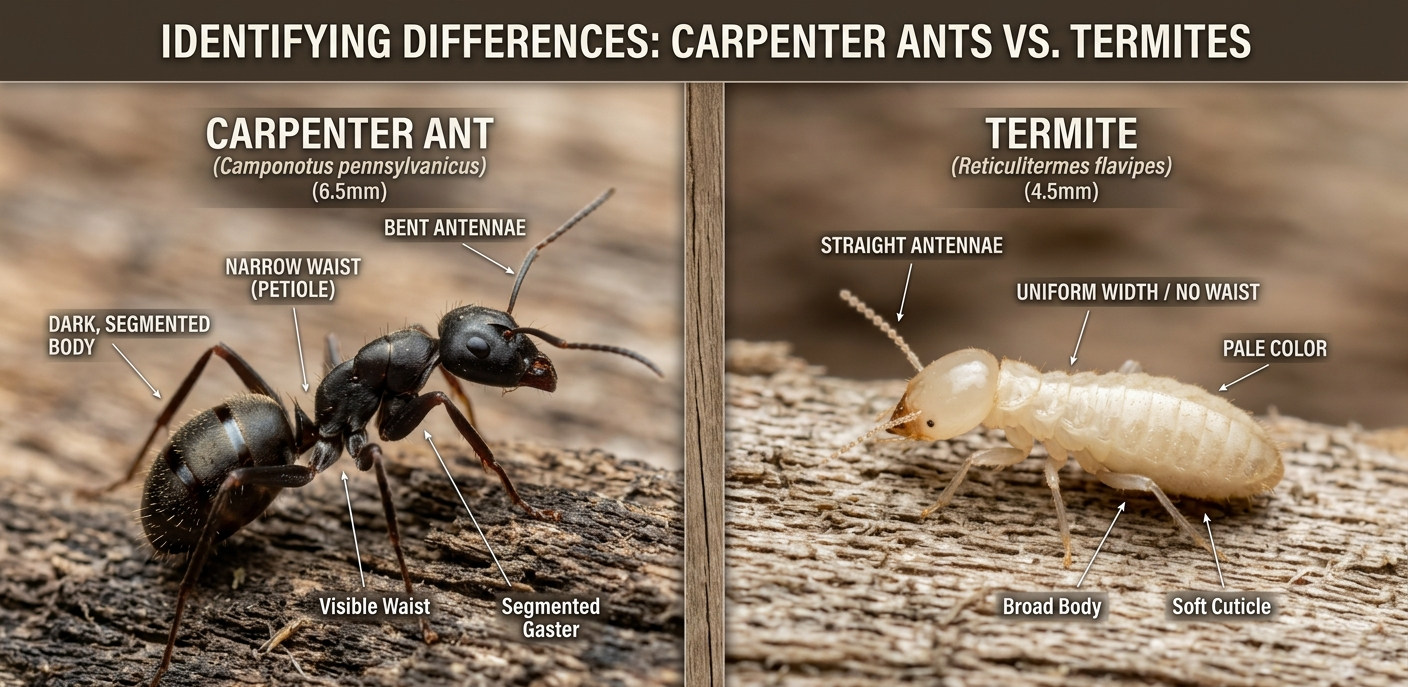
You spotted something on your wall. Maybe it’s a trail of large black bugs near a baseboard. Maybe it’s a beam in your garage that crumbles when you press it. Or maybe you found a pile of what looks like sawdust next to a window frame you know you never sanded.
Whatever tipped you off, you’re now asking the question thousands of Central California homeowners ask every year: is this a termite problem or carpenter ants?
When comparing carpenter ant damage vs termite damage, the difference matters more than most people realize. These pests may look similar and both target wood, but they behave very differently, cause different types of damage, and require completely different treatments.
Guessing wrong can cost you time and money and allow the damage to get worse.
Here is everything you need to know to tell them apart, understand what they are doing to your home, and figure out what to do next.
Are Carpenter Ants and Termites the Same Thing?
No, they are not the same. They are not even closely related. Carpenter ants belong to the ant family, while termites are more closely related to cockroaches.
The confusion is understandable. Both pests:
- Damage wood
- Produce winged swarmers in spring
- Can appear suddenly inside your home
Key Differences at a Glance
- Body shape: Carpenter ants have a pinched waist. Termites have a thick, straight body.
- Antennae: Carpenter ants have bent antennae. Termites have straight antennae.
- Wings: Carpenter ant wings are uneven. Termite wings are equal in size and fall off easily.
- Color: Carpenter ants are dark. Termites are pale or cream-colored.
If you cannot clearly see the insect, the damage they leave behind is often the better clue.
Quick Comparison: Carpenter Ants vs Termites
| Feature | Carpenter Ants | Termites |
| Do they eat wood? | No | Yes |
| Damage speed | Slower | Fast and continuous |
| Damage appearance | Smooth, clean tunnels | Rough, muddy tunnels |
| Visibility | Often seen | Rarely seen |
| Risk level | Moderate | Severe |
| Moisture dependency | High | Moderate |
How Carpenter Ants Damage Your Home
Carpenter ants do not eat wood. That is a common misconception. What they do is excavate it. They chew through wood to build their nests, hollowing out galleries and tunnels where the colony lives and grows.
They strongly prefer wood that has already been softened by moisture. Leaky pipes, poorly sealed windows, water-damaged framing, and damp crawl spaces are all prime targets. This is why carpenter ants are not just a pest problem. Finding them in your home is often a sign that moisture is getting in somewhere it should not be.
The damage carpenter ants leave behind looks clean and almost polished. Their galleries are smooth-walled, with a finished appearance, as if someone ran sandpaper through the inside of the wood. As the colony grows, the tunnels expand, weakening whatever structure they have made home.
Signs of carpenter ant activity include:
- Piles of fine, sawdust-like frass near baseboards, window frames, or door frames. Unlike termite frass, carpenter ant frass contains tiny wood shavings and even small insect parts.
- Faint rustling or crunching sounds inside your walls at night. Carpenter ants are nocturnal, so this is more noticeable after dark.
- Visible trails of large ants, especially near moisture sources like sinks, pipes, or crawl spaces.
- Small, round exit holes on the surface of wood where the ants push debris out.
Left untreated, a carpenter ant infestation can cause significant structural damage over months to years, particularly if moisture issues remain unaddressed.
How Termites Damage Your Home
Termites are a different story. They do not just use wood for shelter. They eat it, continuously, around the clock, without ever coming up for air.
Termites feed on the cellulose inside wood. A mature colony can contain hundreds of thousands of workers consuming wood nonstop, often hidden deep inside walls, floors, and structural beams where no one can see or hear them. This is why termites have earned the nickname “silent destroyers.”
The most common type of termite in California is the subterranean termite. These colonies live underground and build mud tubes, which look like narrow, brownish tunnels running up your foundation walls or along baseboards. Those mud tubes are the highway between their underground colony and the wood they are eating inside your home.
Drywood termites, also present in California, skip the underground colony entirely and nest directly inside the wood they are infesting.
Termite damage looks rough and ragged on the inside, often with soil and mud packed into the galleries. From the outside, the wood may look completely normal until it is too late. Signs include:
- Mud tubes along your foundation, walls, or in your crawl space
- Wood that sounds hollow when tapped
- Paint that bubbles or peels without an obvious water source
- Doors and windows that suddenly stick or warp, as if swelling from humidity
- Tiny pellet-like droppings near baseboards (a sign of drywood termites)
- Discarded wings near windowsills or entry points after a spring swarm
The most alarming thing about termites is how long they can go undetected. By the time visible damage appears, the infestation has often been active for years.
How to Tell Carpenter Ant Damage from Termite Damage
If you are looking at damaged wood and trying to figure out which pest is responsible, here is a quick field check:
Look at the texture of the damage. Carpenter ant galleries are smooth and clean inside. Termite galleries are rough, uneven, and often packed with soil or mud.
Check for frass. Carpenter ant frass looks like coarse sawdust mixed with small debris. It piles up near exit holes. Termite frass (from drywood termites) looks like tiny, uniform pellets, almost like coffee grounds or fine sand.
Tap the wood. Wood heavily damaged by termites will sound hollow because the inside has been consumed. Carpenter ant wood may also sound hollow in places, but the galleries are cleaner.
Look for mud tubes. If you see mud tubes anywhere on your foundation or inside your crawl space, that is a termite indicator. Carpenter ants do not build mud tubes.
Listen at night. If you hear faint rustling or crunching sounds coming from your walls after dark, carpenter ants are a likely culprit. Termites are essentially silent.
When in doubt, the safest move is to have a professional look at it. Misidentifying the pest leads to the wrong treatment, which means the damage continues.
Which Is Worse: Carpenter Ants or Termites?
If you’re comparing carpenter ant damage vs termite damage, here is a quick way to tell:
- Texture: Carpenter ants leave smooth tunnels. Termites leave rough, mud-filled galleries.
- Frass: Carpenter ant frass looks like sawdust with debris. Termite frass looks like tiny pellets.
- Sound: Termite-damaged wood sounds hollow. Carpenter ant damage may sound hollow but cleaner.
- Mud tubes: Only termites build mud tubes.
- Activity: Carpenter ants are active at night. Termites remain hidden.
When in doubt, professional identification is the safest move.
Which Is Worse: Carpenter Ants or Termites?
If you’re asking “carpenter ants vs termites which is worse,” the answer is clear: termites.
Termites cause billions of dollars in damage each year in the U.S. because:
- They eat wood continuously
- They remain hidden for long periods
- Colonies grow large and aggressive
Carpenter ants can still cause serious damage, especially in moisture-damaged homes, but the destruction is typically slower.
Bottom line:
- Termites = faster, more severe structural damage
- Carpenter ants = slower damage but still a serious warning sign
Neither pest should be ignored.
Can You Have Both at the Same Time?
Yes, and it is more common than most homeowners expect.
Moisture, aging wood, and structural gaps can attract both pests at once. Treating only one problem may leave the other unchecked.
A full inspection ensures nothing is missed.
What Is the Hardest Pest to Get Rid Of?
Between the two, termites are harder to eliminate.
Subterranean termites live underground, and treating visible damage does not remove the colony. Effective treatment often requires:
- Soil treatments
- Bait systems
- Long-term monitoring
Carpenter ants can also be difficult due to multiple nesting sites, but they are generally easier to control once the source is found.
Stop Guessing. Protect Your Home Before the Damage Gets Worse.
If you’re seeing signs of wood damage, swarmers, or unexplained debris, the worst thing you can do is wait and hope it’s nothing. Both carpenter ants and termites can quietly expand their damage while you’re still trying to figure out what you’re dealing with.
The sooner you identify the problem, the easier and less expensive it is to fix.
At RidX Pest Control, we don’t give you generic answers or one-size-fits-all treatments. We take the time to inspect your home, identify exactly what’s happening, and explain your options clearly so you can make the right decision.
Whether it turns out to be carpenter ants, termites, or both, you’ll know exactly where you stand and what to do next.
Contact us and schedule your inspection with RidX today and get real answers before a small issue turns into a major repair.
Frequently Asked Questions
How to tell the difference between carpenter ant damage and termite damage?
Carpenter ant damage is smooth and clean, while termite damage is rough, uneven, and often packed with mud. Termites may also leave mud tubes, which carpenter ants do not create.
Can carpenter ants be mistaken for termites?
Yes, especially during swarming season when both produce winged insects. Carpenter ants have a narrow waist and bent antennae, while termites have straight bodies and straight antennae.
Are carpenter ants and termites the same?
No, carpenter ants and termites are completely different insects. Carpenter ants excavate wood to build nests, while termites consume wood as their primary food source.
Are carpenter ants worse than termites?
In most cases, termites are worse because they eat wood continuously and can cause severe structural damage faster. Carpenter ants damage wood more slowly but can still cause serious issues over time.
What does wood damage from carpenter ants look like?
Carpenter ant damage appears as smooth, hollowed-out tunnels inside wood, often with sawdust-like debris called frass nearby. The galleries look clean compared to termite damage.
What is the hardest pest to get rid of?
Termites are generally harder to eliminate because they live in large, hidden colonies, often underground. Effective treatment usually requires professional methods like bait systems or soil treatments.
Can you have carpenter ants and termites at the same time?
Yes, homes with moisture issues or structural vulnerabilities can attract both pests. This is why a professional inspection is important to ensure all infestations are properly identified and treated.
